
Understanding the difference between Satisfaction and Engagement
…and why both matter for your work climate
Who is this note for?
Leaders and HR professionals who receive Yumodata survey results and want to really understand what the indicators “Satisfaction” and “Engagement” are telling them.
After reading this note, you will be able to:
- Explain in one sentence what satisfaction is and what engagement is
- Understand why they can move in different directions
- Use both indicators to guide concrete leadership action
1. The everyday experience behind the numbers
Think of a time when you felt like this:
“My job is ok. Pay is fair, colleagues are fine, the office is decent… but honestly, I’m just going through the motions.”
And another time when:
“Right now work is tough – deadlines are tight, days are long – but I care about what we’re doing, and I still want to give my best.”
These are two very different inner states.
They are the reason why Yumodata does not use one single “employee mood score”, but instead measures:
- Satisfaction – Am I okay in my working conditions?
- Engagement – Do I want to give my best here?
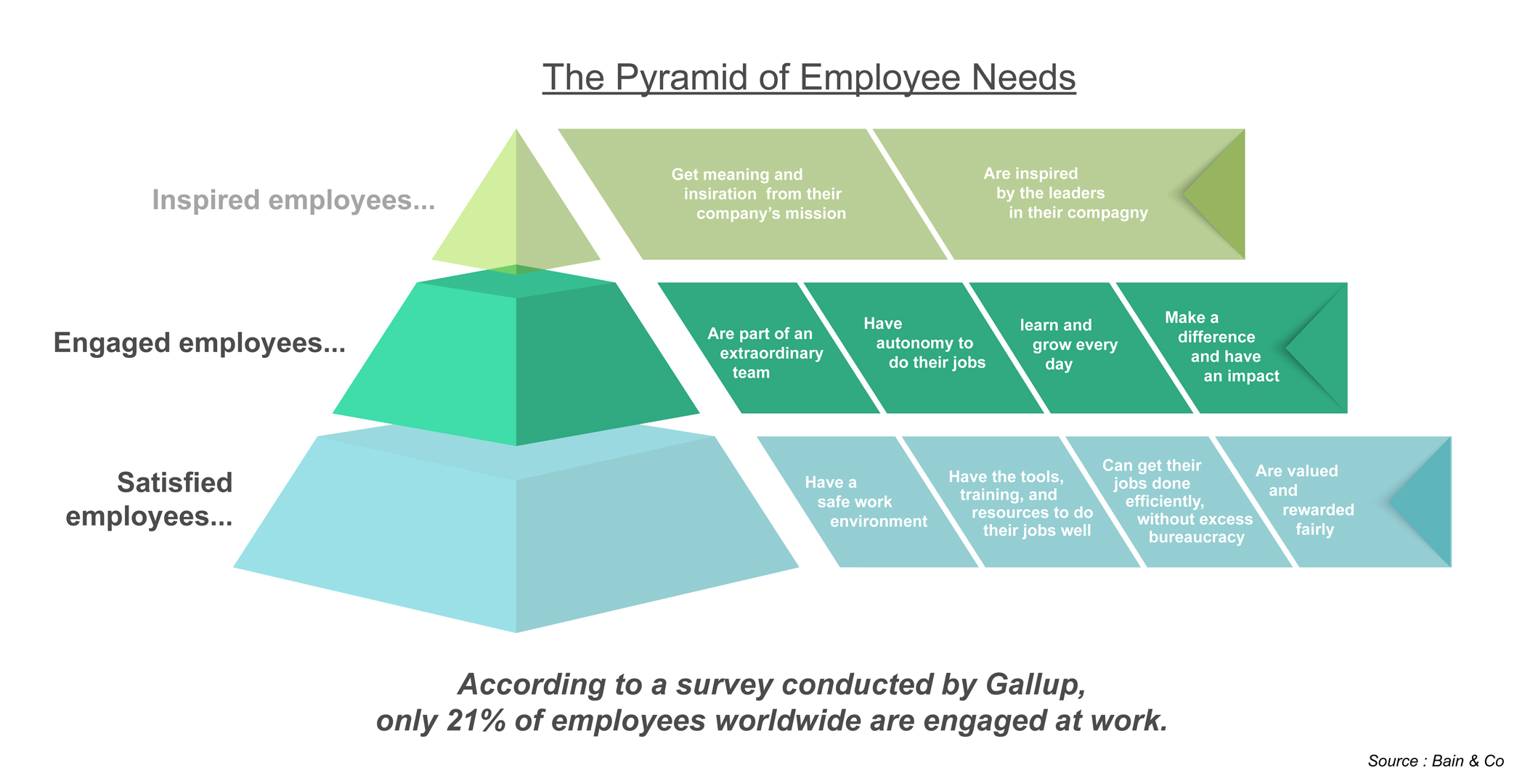
The Yumodata indicators are inspired by the Pyramid of Employee Needs introduced by Eric Garton and Michael Mankins in Harvard Business Review (2015). Their work shows that people first need to be satisfied with the basics of their job, and only then can they become engaged or even inspired. That resonated with us.
For Swiss organizations in particular, Yumodata focuses on two levels that are universally relevant:
- Satisfaction – the foundation
- Engagement – the energy and commitment people bring
2. What we measure as “Satisfaction”
2.1 What it means
In research, job satisfaction is defined as how positively someone evaluates their job overall – essentially, how much they like their job.
In Yumodata, the Satisfaction indicator captures whether the basic expectations of work are met:
- Is my workload manageable?
- Is my pay and recognition fair enough?
- Do I have the tools and information I need?
- Are processes and IT workable rather than constantly blocking me?
- Is the work environment safe and respectful?
These elements are inspired by the foundation of the Bain & Company pyramid: if they are weak, frustration quickly dominates.
2.2 What satisfaction tells you as a leader
When you look at the Satisfaction indicator, you are essentially asking:
“How solid is our basic work environment?”
Low or declining satisfaction points you toward:
- Overload or unclear priorities
- Perceived unfairness (pay, promotions, decisions)
- Dysfunctional tools, systems, or bureaucracy
- Lake of training
- Concerns about security or respect
Improving satisfaction usually requires structural or process changes – not just nicer communication.
3. What we measure as “Engagement”
3.1 What it means
Work engagement is a more active state. Leading researchers define it as a positive, fulfilling, work-related state of mind characterized by:
- Vigor – high energy and willingness to invest effort
- Dedication – a sense of significance, enthusiasm, and pride
- Absorption – being deeply involved in one’s work; time passes quickly
In everyday words, engagement is:
“How much of my energy, heart, and focus I actually bring to my job.”
3.2 What drives engagement
In yumodata, the Engagement indicator reflects whether people experience things like:
- Meaningful tasks they can be proud of
- Autonomy and trust in how they do their work
- The chance to use and develop their skills
- Supportive leadership with clear direction
- Strong teams and collaboration
- A feeling that their work makes a difference to customers, patients, citizens, etc.
These are classic job resources in the Job Demands–Resources (JD-R) model, which shows that such resources drive engagement and good performance over time.
3.3 What engagement tells you as a leader
Looking at engagement is like asking:
“Are people emotionally and mentally on board with what we’re trying to achieve?”
Low engagement suggests:
- People don’t see the point of their work
- They feel ignored, under-used, or micro-managed
- They no longer want to go beyond the bare minimum
Addressing engagement issues is mostly about leadership quality, team climate, and meaningful work design.
4. Why satisfaction and engagement can sometimes move in different directions
4.1 Different parts of the job react to different things
The JD-R model helps explain this:
- Job demands (workload, time pressure, emotional strain, complexity) are strongly linked with stress, exhaustion, and lower satisfaction.
- Job resources (autonomy, support, feedback, learning) are strongly linked with engagement and performance.
That means:
- If demands increase (more work, more admin, more pressure, increasing process issues), satisfaction will often fall.
- If resources are still intact (good manager, strong team, meaningful tasks), engagement can remain stable – at least for some time.
5. Reading your Yumodata results: 4 basic patterns
When you combine both indicators, four typical situations emerge:
- High satisfaction, high engagement
- People feel well treated and highly committed
- Focus: protect and scale what works; keep listening to early warning signals
- Low satisfaction, high engagement
- People care and try hard, but feel under strain
- Focus: relieve pressure, fix processes and tools, clarify priorities
- High satisfaction, low engagement
- People are comfortable but not energized – “it’s fine, but…”
- Focus: strengthen leadership, autonomy, development, and purpose
- Low satisfaction, low engagement
- People are both unhappy and disengaged
- Focus: urgent, combined action on working conditions and leadership
6. Academic references & further reading
For readers who want to go deeper:
Job satisfaction & performance
- Judge, T. A., Thoresen, C. J., Bono, J. E., & Patton, G. K. (2001).
The Job Satisfaction–Job Performance Relationship: A Qualitative and Quantitative Review. Journal of Applied Psychology, 86(1), 80–92.
Work engagement
- Schaufeli, W. B., & Bakker, A. B. (2004).
Job Demands, Job Resources, and Their Relationship with Burnout and Engagement. Journal of Organizational Behavior, 25, 293–315. - Bakker, A. B. (2015).
Work Engagement. Wiley Encyclopedia of Management.
Job Demands–Resources model
- Demerouti, E., Bakker, A. B., Nachreiner, F., & Schaufeli, W. B. (2001).
The Job Demands–Resources Model of Burnout. Journal of Applied Psychology, 86(3), 499–512. - Bakker, A. B., & Demerouti, E. (2007).
The Job Demands–Resources Model: State of the Art. Journal of Managerial Psychology, 22(3), 309–328.
Bain pyramid & productivity
- Garton, E., & Mankins, M. (2015).
Engaging Your Employees Is Good, But Don’t Stop There. Harvard Business Review, December 9.